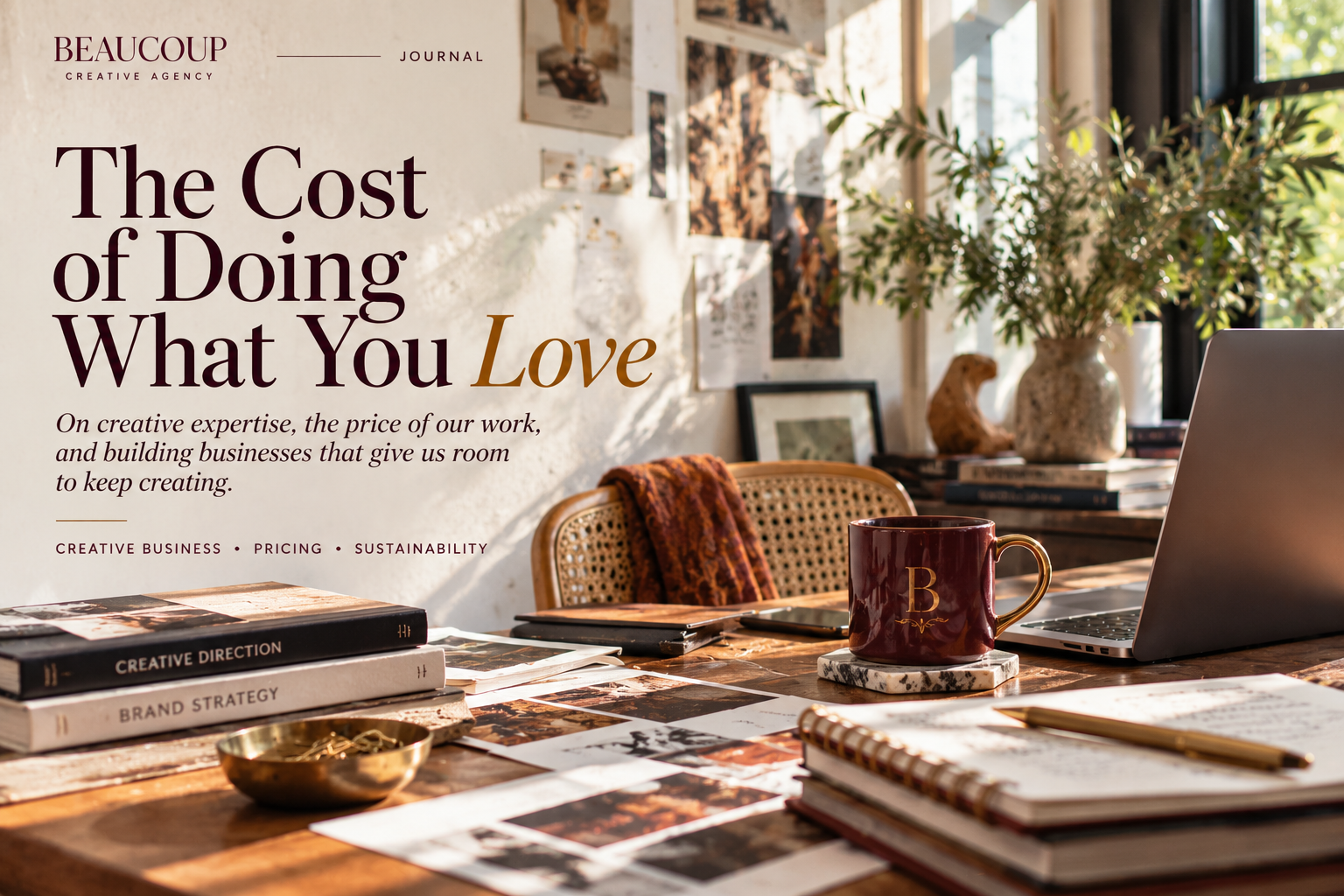
On creative expertise, the price of our work, and building businesses that give us room to keep creating.
There is something particularly complicated about making a business out of something you genuinely love.
You spend years developing your eye, refining your instincts, learning your craft, and figuring out how to turn an idea into something tangible. Eventually, you become good enough at what you do that people want to pay you for it.
And then comes the interesting part.
You have to decide what all of that is worth.
I’ve spent much of my career working at the intersection of creativity, production, and business. I’ve seen what goes into bringing ambitious ideas to life, from the first conversation to the final deliverable. I’ve also seen how easily the work behind the work gets overlooked.
The research. The thinking. The years of experience that allow you to recognize a problem before it becomes an expensive one. The ability to walk into a complicated situation and figure out what needs to happen next.
None of that is accidental.
Yet creative professionals are often expected to make all of it look effortless.
The work isn’t always what people see
A client might come to you for a brand identity, a website, a campaign, or a creative direction for their next big idea.
What they’re purchasing is rarely just the finished product.
They’re also purchasing your judgment. Your ability to ask the right questions, recognize what isn’t working, anticipate challenges, and make decisions that move the project forward.
They’re benefiting from the mistakes you’ve already made, the problems you’ve already solved, and the experience you’ve accumulated along the way.
That’s part of the value.
And it can be surprisingly difficult to put a price on something that has become second nature to you.
When you’ve spent years developing a particular skill, you sometimes forget that what comes naturally to you is precisely what someone else needs your help with.
But there’s another side to this conversation that I think deserves more attention.
Passion doesn’t pay the overhead
We talk a lot about following our passions, building businesses around our gifts, and doing work that feels meaningful.
I’m all for it.
But I also believe we need to have more practical conversations about what it takes to sustain that work.
Creative businesses have expenses. Software, equipment, contractors, insurance, administrative work, professional development, and the countless hours spent running the business when you’re not actually creating anything.
There is also the cost of your time.
Not just the hours you spend producing something, but the time required to manage client relationships, prepare proposals, develop concepts, revise deliverables, and keep everything moving.
And then there’s the time you need to live an actual life outside your business.
When we price our work without accounting for those realities, we’re not necessarily making our services more accessible. Sometimes we’re simply absorbing costs that should have been part of the conversation from the beginning.
A business can be creatively fulfilling and financially unsustainable at the same time.
Both things can be true.
Not every opportunity is an opportunity
One of the more difficult lessons in business is recognizing that being capable of doing something doesn’t automatically mean you should agree to do it.
Especially when you’re building something of your own.
It’s tempting to accept projects because you like the client, believe in their mission, want to strengthen the relationship, or simply need the revenue.
Those are understandable reasons.
But every project comes with a commitment of time, energy, and resources. And every commitment affects your capacity to take on something else.
I’ve always appreciated working with people who are genuinely invested in what they’re building. The artists, entrepreneurs, organizations, and businesses doing work that reflects something meaningful about who they are.
Those are the relationships I want to cultivate through Beaucoup.
But supporting someone’s vision shouldn’t require compromising the sustainability of your own.
There has to be room for both.
Generosity and sustainability can coexist
I don’t believe every business decision needs to be reduced to maximizing profit.
Sometimes you want to support an emerging artist. Sometimes a community organization is doing important work with limited resources. Sometimes you believe in a project enough to offer a different pricing arrangement.
There’s nothing inherently wrong with that.
The distinction is whether you’re making that decision intentionally or routinely discounting your expertise because you’re uncomfortable asking to be compensated.
Generosity is much easier to sustain when it comes from a business that can afford to be generous.
Maybe that means offering a limited number of community projects each year. Maybe it means developing smaller service packages that make professional creative support more accessible. Or perhaps it means adjusting the scope of a project rather than reducing the value of the work itself.
There are ways to meet people where they are without making your business responsible for closing every financial gap.
And sometimes, despite the best intentions on both sides, the timing or budget simply isn’t right.
That’s part of business, too.
Building something you can actually live with
As I continue developing Beaucoup Creative Agency, I find myself thinking more about the kind of business I want to operate, not just the kind of work I want to produce.
I want to collaborate with interesting people. Make thoughtful, culturally resonant work. Build relationships that extend beyond a single project. Have the freedom to experiment, explore ideas, and occasionally pursue something simply because it feels worth creating.
I also want the business behind that work to make sense.
That requires paying attention to pricing, project scope, operating costs, client relationships, and the way I allocate my time.
It means recognizing that every yes comes with a responsibility, and that having the capacity to deliver something matters just as much as having the talent to create it.
It also means being willing to revisit decisions as the business evolves.
I don’t think sustainable creative ownership is about reaching some magical point where every project is profitable, every client is ideal, and every decision feels easy.
It’s about building enough stability and flexibility that the work you love doesn’t eventually become the thing that exhausts you.
Because what we’re creating should have room to grow.
And so should we.
__________________________________
BEAUCOUP CREATIVE AGENCY
Where Strategy Meets Soul.
Branding, creative direction, and creative operations for businesses, artists, and organizations building something meaningful.